
A public recipe does not make its bookmark history public
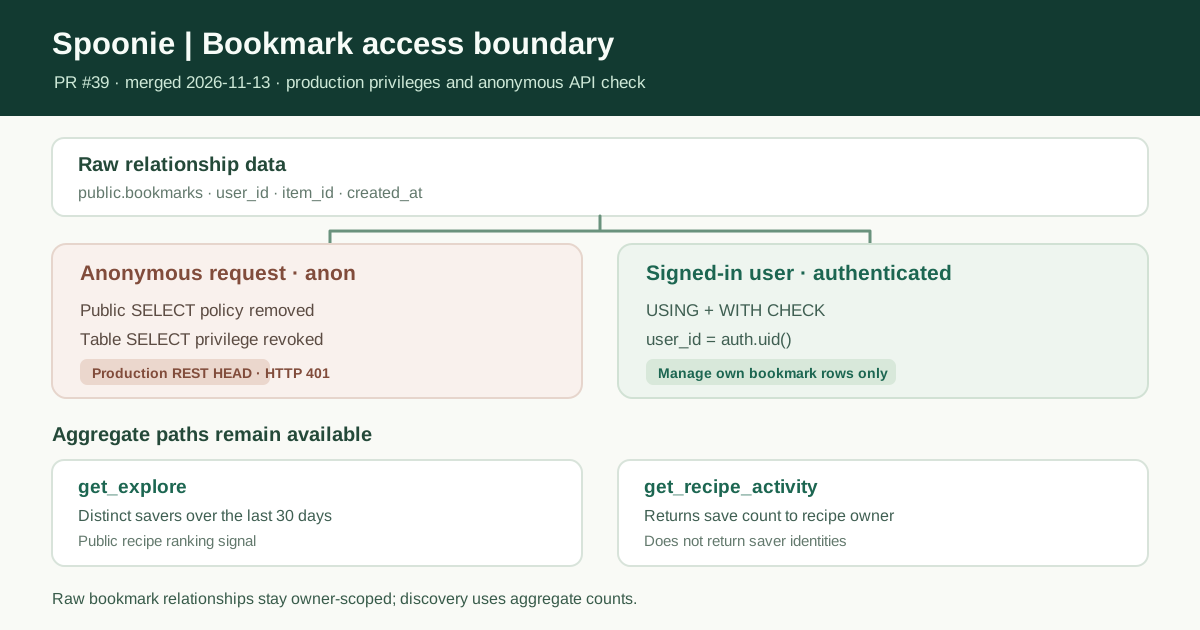
Spoonie now blocks anonymous REST requests from reading raw bookmark rows. PR #39 merged on November 13, 2026. It removes the broad SELECT policy from public.bookmarks and revokes table-level SELECT from PostgreSQL’s anon role. On November 15, the production migration ledger contained one application record, RLS was enabled, and an anonymous HTTP HEAD request returned 401.
A bookmark records a relationship between an account and an item. Publishing a recipe does not require publishing the identity of everyone who saved it. PR #39 enforces that distinction in the database.
The old public read path
Row-level security (RLS) was enabled on bookmarks, but a broad policy named All users can view bookmarks remained in place alongside SELECT permission for the anon role. Together, those settings allowed an unauthenticated client to query raw user-to-item bookmark relationships.
The client repository filters its query with .eq('user_id', userId). That limits the normal screen request. A caller can bypass the UI and send a REST request directly, so the database must enforce the same ownership rule.
Anonymous reads are denied; owner access remains
The PR #39 migration closes the public read path with two statements:
drop policy if exists "All users can view bookmarks" on public.bookmarks;
revoke select on table public.bookmarks from anon;
The first removes the broad row-visibility policy. The second removes the anonymous role’s table-level SELECT privilege.
The existing authenticated policy, Users can manage their bookmarks, remains in place. Its USING and WITH CHECK clauses both require user_id = auth.uid(), so a signed-in user can manage only rows owned by that account. The production database also retains authenticated SELECT, INSERT, UPDATE and DELETE privileges.
Recipe discovery uses counts rather than saver identities
Blocking anonymous access to raw bookmark rows leaves the product’s aggregate save signals available.
get_explore uses the count of distinct non-owner accounts that saved each public recipe during the previous 30 days as one ranking signal. It does not return those accounts. get_recipe_activity returns a save count to the authenticated owner of a recipe and omits the saver list.
Public discovery can therefore use aggregate activity while raw bookmark relationships remain scoped to their owners.
Production verification
The production database records migration 20261113054444 once. RLS is enabled on public.bookmarks; anon has no SELECT privilege; authenticated SELECT, INSERT, UPDATE and DELETE privileges remain.
| Check | Production result |
|---|---|
Migration 20261113054444 | One recorded application |
RLS on public.bookmarks | Enabled |
| Anonymous SELECT privilege | Revoked |
| Authenticated SELECT / INSERT / UPDATE / DELETE | Retained |
SELECT policies available to anon | 0 |
| Anonymous REST request | HTTP 401 |
The PR adds a Vitest contract test for the migration and the user-scoped client query. The live HTTP HEAD check returned 401 and transferred no bookmark rows.
I did not run a production end-to-end test with two real member accounts switching sessions. The checks here cover the migration record, database permissions and anonymous REST access.
Source and related work
- Spoonie PR #39: prevent anonymous bookmark relationship disclosure
- Merge commit
- Spoonie project overview
- Separating likes and saves by viewer
- Removing newly private posts from other viewers’ caches
- Spoonie