
My tools drew 300 Google Search clicks in 37 days
Google Search brought 300 clicks and 3,601 impressions to pages on my GitHub Pages property in the 37 days from October 15 through November 20, 2026. I checked the original URL-prefix property in Google Search Console using finalized Web search data. Its reported click-through rate was 8.33%.
The pages people reached were not a generic portfolio landing screen. Search was bringing them to tools and documentation I built to answer particular questions: a scratch-ticket simulation, a printer troubleshooting guide and a browser-based face-comparison experiment.
The pages people clicked from Google
| Page | Search clicks | Search impressions |
|---|---|---|
| Scratch Lottery simulator | 120 | 1,416 |
| Epson waste-ink-pad guide | 88 | 485 |
| RichChecker face-comparison experiment | 73 | 236 |
These are page-level results, reported separately from the 300-click property-wide total. Search Console aggregates property and page reports differently. Adding these rows or subtracting them from 300 would not give a reliable total for the other pages.
The property also includes code and content that live under one GitHub Pages hostname without sharing a single application repository. The numbers above describe the search visibility of those exact URLs, not all the products I operate on other domains.
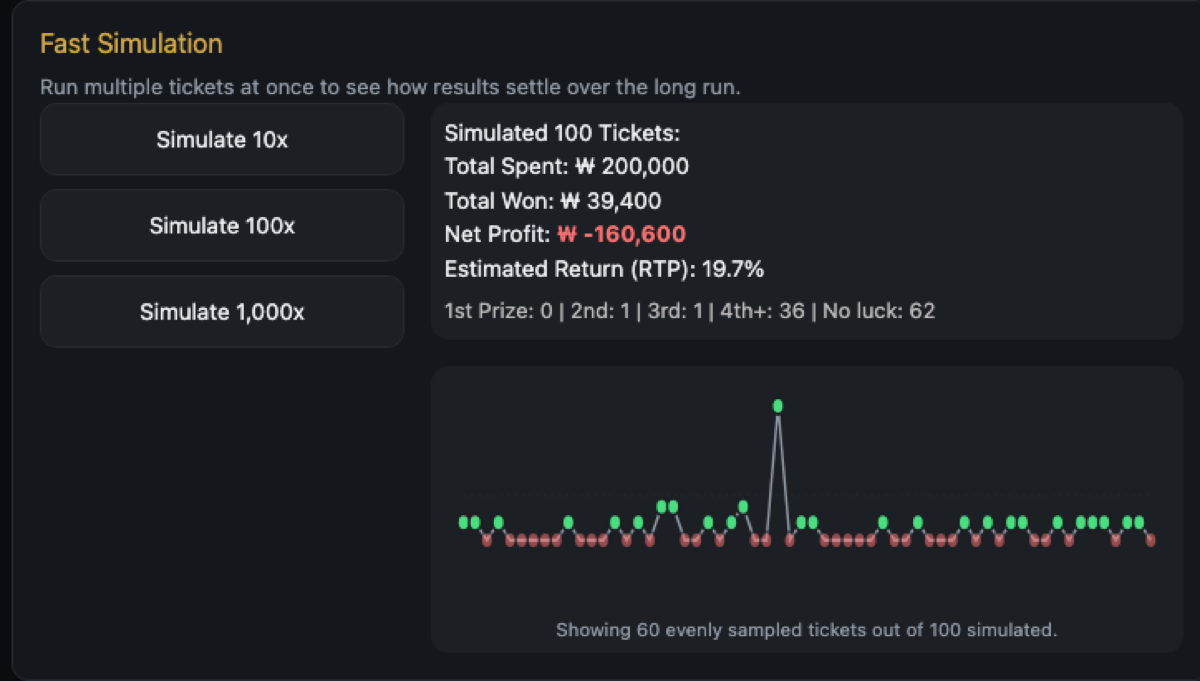
This is the simulator’s own interface, not a screenshot of the Search Console report. The measurement period and metric definitions come from the first-party report.
What I built, and what the numbers tell me
Scratch Lottery simulates ticket outcomes. I built the interaction, the probability controls and faster batch simulation. Its 120 Google-result clicks indicate that the tool was found through search. They do not reveal whether someone ran a simulation or returned for another session.
The Korean Epson guide documents a real printer-maintenance problem and the model-specific limits of possible fixes. Its 88 Google-result clicks are a reason to keep the model cautions prominent, not evidence that 88 printers were repaired. I previously checked the bilingual guide’s acquisition using GA4 and Search Console over different earlier windows; those figures cannot be added to this overlapping report.
RichChecker is a browser-based facial-feature comparison experiment. Its 73 Google-result clicks establish discovery of the page, not use of the camera, completion of an analysis or any scientific validity of the comparisons.
The useful engineering signal is that a focused tool or a carefully scoped guide can be found for the problem it addresses. I can evaluate each entry point against the question that brought a searcher to it, then improve the tool or the surrounding explanation instead of assuming a successful task from the click alone.
How the measurement was checked
I queried the verified original Google Search Console URL-prefix property for Web search, October 15–November 20, 2026, with final data. One report used property aggregation for 300 clicks, 3,601 impressions and 8.33% CTR. A separate page aggregation returned the individual URLs above. This is Google search-result interaction data, not Google Analytics sessions.
The aggregate, non-identifying report snapshot records the query scope, figures and limitations. The underlying Search Console property is private, so readers cannot independently rerun the owner report from that public JSON.
The confirmed outcome is 300 Google search-result clicks to this property during the stated window. The report does not establish 300 distinct people, product sign-ups, completed tasks or adoption. That distinction is part of how I evaluate software I have shipped.
The portfolio now separates this first-party measurement from its external publications and resource listings, which are independently sourced records rather than traffic reports.