
My Jekyll project pages were being published as blog posts
Three pages in my developer portfolio were emitting BlogPosting structured data with a publication timestamp that came from the build. The pages were project cases for KoreAves, Space Atlas, and Spoonie. In PR #98, I changed which Liquid condition runs first and checked all three rendered pages after deployment.
The mistake was in the template. It had been using page.date as the first test for whether a document was a blog post. During the project-page build, that value was present, so a project case reached the BlogPosting branch. The output made a project overview appear to be a dated article.
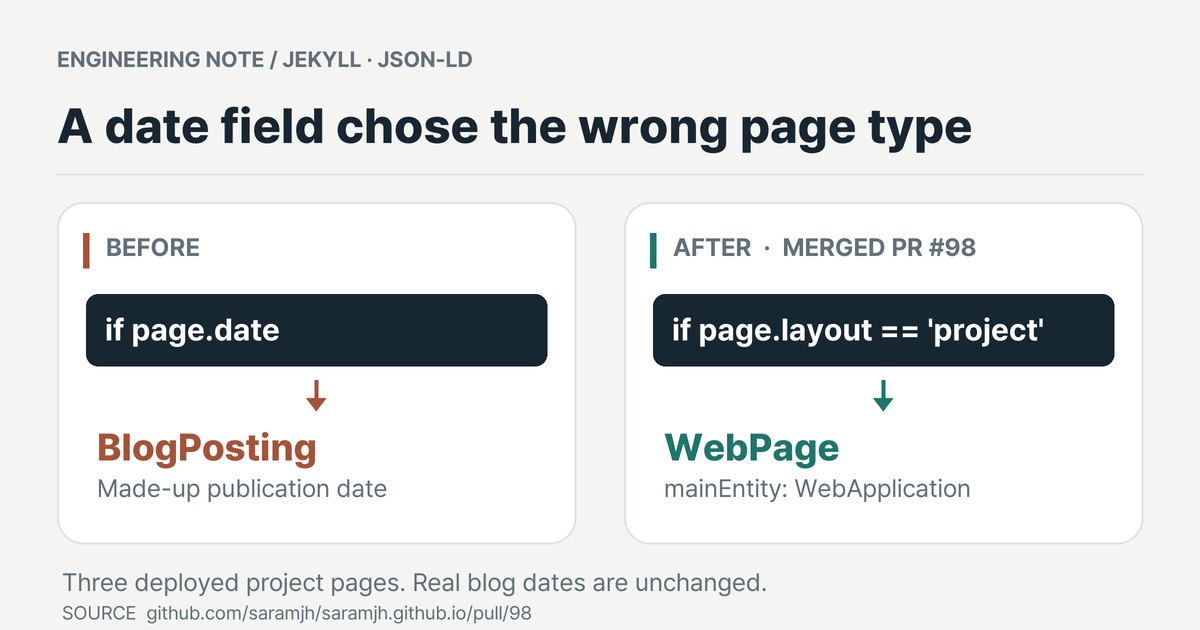
Where the wrong type came from
The old Liquid selector tested for page.date before checking the project’s layout. In the build output, that condition was true for the project documents. The generated JSON-LD used BlogPosting and supplied datePublished from the document’s date value.
The deployed template checks a more specific identity first:
{% if page.layout == 'project' and page.site_url and page.slug %}
  {# WebPage with a WebApplication mainEntity #}
{% elsif page.date %}
  {# BlogPosting for a dated article #}
{% endif %}
The snippets above show the decision order. The exact merged diff contains the JSON-LD and Liquid filters.
What the project pages now describe
Each project case is a WebPage whose mainEntity is a WebApplication. I bind the application’s name, summary, website, image, and author to the page’s existing front matter rather than copying those fields into a second manually maintained list.
The optional subjectOf entries refer to source-verified external directory listings already recorded in the site data. They are separate WebPage objects, not endorsements, reviews, star ratings, or partner claims. The deployed source has five such entries for KoreAves, one for Space Atlas, and two for Spoonie. Those are counts of existing references in the schema, not new placements.
How I checked the result
I added a regression test that requires the project branch to appear ahead of the date branch. The test also checks that project URLs and names are drawn from their first-party project files. The full Jekyll build passed alongside 95 Python tests and three existing portfolio JavaScript tests.
After GitHub Pages deployment, I fetched all three published case pages and parsed their application/ld+json scripts. Each returned HTTP 200 with a WebPage and a WebApplication. Their synthetic datePublished and dateModified values were gone. I checked one dated science article as a control: it still emits BlogPosting with its actual November 12 date.
For a similar Jekyll bug, inspect the rendered HTML, not only the front matter. A successful build proves that the Liquid template ran; parsing its resulting JSON-LD shows which branch actually won. The Schema.org WebApplication definition describes the intended entity type; it does not promise search rankings or a rich result. I have not measured search-index changes, traffic or reader adoption from this fix.