Education / scientific visualisation
Space Atlas
Interactive astronomy for learners
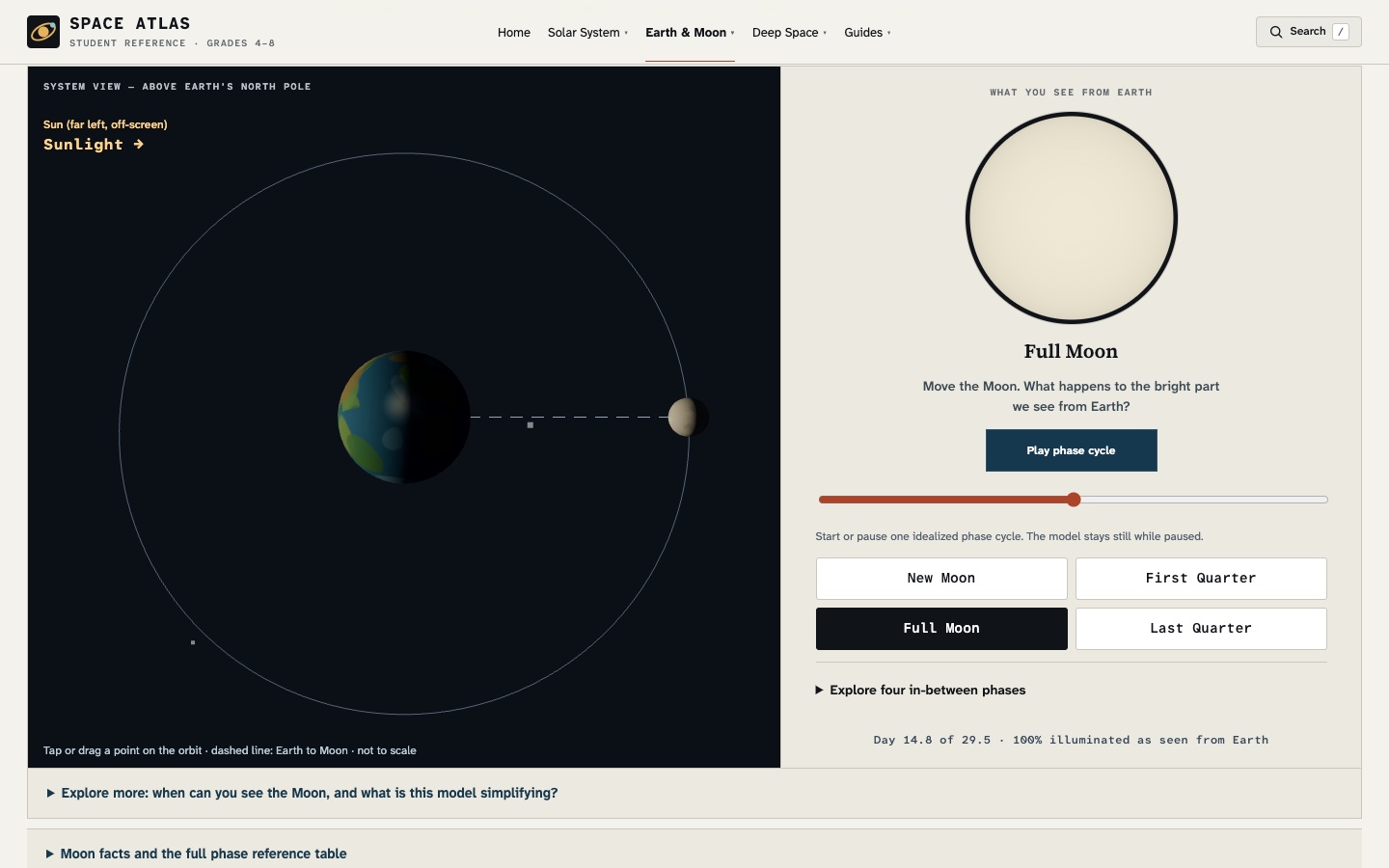
Browser-based space-science models that let students change variables and inspect why textbook diagrams simplify reality.
The problem
Static diagrams make it easy to memorise astronomy vocabulary while missing the physical relationships between scale, position, illumination, and observation.
What I built
A collection of interactive learning models, including Moon phases, Earth seasons, orbital motion, planetary scale, and exoplanet transits. Students can adjust variables and compare different views.
Engineering decisions
- Expose assumptions and simplifications in classroom models.
- Pair interactive scenes with explanatory text and the next relevant topic.
- Use 3D where spatial reasoning is useful and 2D where it is clearer.
- Keep controls usable on smaller screens.
Scientific claims in the live lessons
In PR #2, I corrected four astronomy explanations, including the scale of the illustrative solar-system model and the uncertainty of a Milky Way–Andromeda merger. The revised text is on the live site. My English development note and Korean edition link the exact pages and NASA evidence. This was a lesson-copy correction, not a physics-engine change.
Published writing and educator discovery
EUSci published my astronomy essay, Three Space Diagrams, Three Missing Clues, on November 10, 2026. It carries my author credit and explains missing viewpoints in familiar diagrams of Moon phases, seasons and eclipses. I developed those explanations while building the Space Atlas learning models. The English development note and Korean edition connect the published article to the interactive lessons.
Space Atlas also appears in the NCASE Programs directory. Its English record and Korean record explain the listing and its limits. I published a separate Moon Phases activity on Share My Lesson in October 2026, pairing the simulator with a prediction and explanation worksheet for grades 4 to 8. The Korean activity note documents the same resource.
These are verifiable publications and discovery routes. They do not establish school endorsement, classroom adoption or learning outcomes. For the original engineering overview, see English or Korean.
Earth seasons activity
The English case study and Korean edition describe a guided 12–15-minute activity for grades 5–8. Students compare Earth’s usual 23.5° axial tilt with a hypothetical 0° tilt using a globe and an LED lamp. The original two-page worksheet is available on Space Atlas. For the interactive model, open the Earth seasons simulator. The case studies also document its appearance in The Home Ed Daily’s science directory; they do not establish classroom use or an original listing date.
Explore a model
Open Gravity Lab to compare a 3.0 m/s jump across worlds, or try Moon Phases to explore lunar illumination.
The new English case study and 한국어 개발 기록 explain the Gravity Lab comparison, the separate Flight Trials game and Moon Orbit Catcher. They also cover where the simplified models stop matching the physical systems. The original introduction describes the initial project scope.
Evidence and external reach
Independent references
These records describe a publication, directory inclusion or data-use entry. None implies institutional endorsement.
- Publication
EUSci Published contribution
Three Space Diagrams, Three Missing Clues #
Jihun Oh is credited as author; EUSci identifies Priscilla Wong as editor. External publication, not university endorsement or classroom adoption. Developer notes: 한국어 English
- Directory listing
The Home Ed Daily External listing
Space Atlas: Test a No-Tilt Earth #
A UK home-education science directory lists the free, two-page adult-led Earth-seasons investigation for ages 10–14 and links directly to the original worksheet. Independent directory inclusion, not measured family use, classroom adoption, or learning outcomes. Developer notes: 한국어 English
- Directory listing
Awesome Homeschooling External listing
Space Atlas in homeschooling science resources #
Creator-submitted Space Atlas resource link merged by the list maintainer. A community science listing, not verified classroom use or institutional endorsement. Developer notes: 한국어 English
- Directory listing
Awesome Physics External listing
Space Atlas in the astrophysics resource list #
Creator-submitted link to the original open-source astronomy models merged by the list maintainer. A community directory entry, not scientific peer review or measured adoption. Developer notes: 한국어 English
- Directory listing
Kids Edutainment Links External listing
Space Atlas in kids' astronomy learning links #
Creator-submitted interactive Moon phases, Earth seasons and scale models merged by the list maintainer. The directory link does not establish classroom adoption or endorsement. Developer notes: 한국어 English
- Directory listing
Awesome MINT Kids Resources External listing
Space Atlas Student in children's science resources #
Creator-submitted browser models and teacher activity link merged by the list maintainer. Its audience is parent- and teacher-guided science; no teaching outcomes were measured. Developer notes: 한국어 English
- Directory listing
Awesome Interactive Learning External listing
Space Atlas among interactive astronomy resources #
Creator-submitted Moon-phase and Earth-season visual models merged by the list maintainer. The resource link is not a product review or evidence of actual learner use. Developer notes: 한국어 English
- Directory listing
StudentSuite Awesome Study Resources External listing
Space Atlas in free interactive study resources #
Creator-submitted astronomy models and teacher activity link merged by the list maintainer. A community resource entry, not a teaching partnership or measured adoption. Developer notes: 한국어 English
- Directory listing
WorldlyTribe External listing
Online homeschool programs for travelling families #
WorldlyTribe lists Space Atlas as a free science resource for ages 9–14 in its travelling-family guide. Developer notes: 한국어 English
- Directory listing
NCASE Programs External listing
Space Atlas — interactive astronomy models #
NCASE lists Space Atlas by Jihun Oh; a directory entry, not accreditation, endorsement or proven classroom use. Developer notes: 한국어 English