
What Can Instagram Comments Tell Us About Customer Relationships?
한국어로 읽기: Instagram 댓글로 고객 관계를 이해할 수 있을까?
I went back through the small SocLab Instagram pilot to see what I could actually rely on. With one permitted Professional account, I could trace an accessible comment or owner reply to its source post. I could not recover every earlier DM or tell whether a real collaboration had been agreed. It would be easy to turn those gaps into tidy but misleading relationship labels.
What the pilot establishes: Accessible comments and replies can give a relationship record a source. They do not establish a complete DM history, a commercial agreement, someone else’s feelings or a current intent to buy.
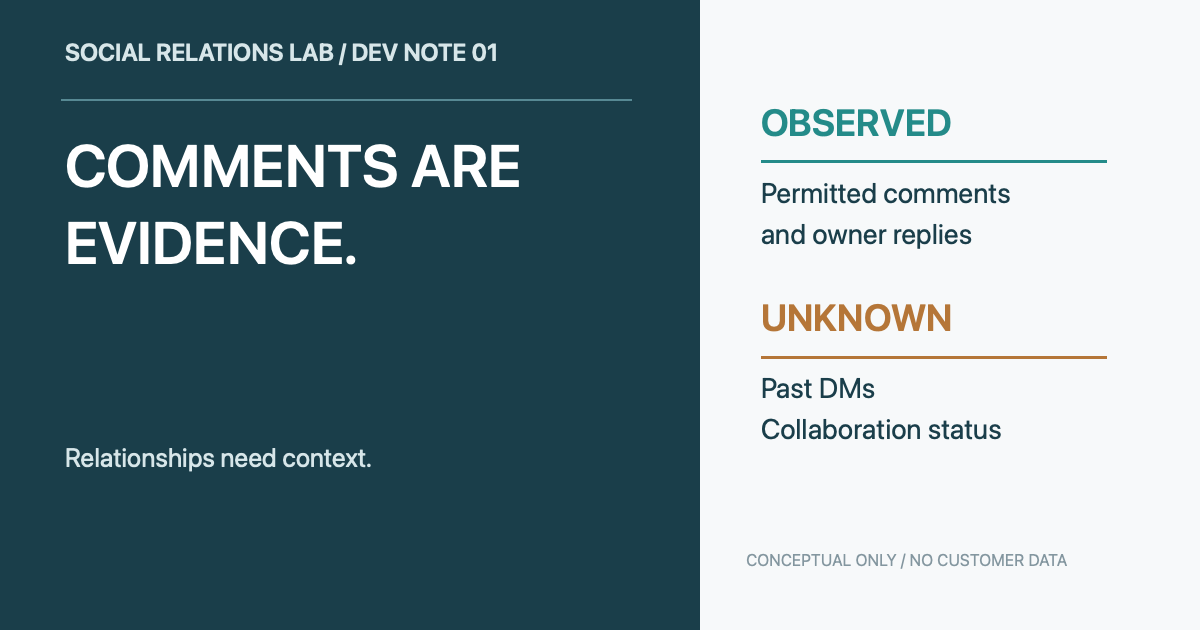
I’m trying to build something more useful than a set of connected profile cards: a place where someone can distinguish an observed exchange from an operator’s own note, see what is still missing, and decide what to check before getting back in touch.
This is a development note about a local prototype, not an announcement that people can already connect their own accounts. The rest of the article separates the part I could verify from the experience still to be built.
What the local Instagram pilot verified
Development records dated October 25–26, 2026 describe a single explicitly authorized Instagram Professional account used for a local proof of concept. Within the permissions available for that account, the system observed comments and owner replies, preserved source-linked relationship events, and tested an early per-contact summary.
This supports four narrow claims:
- Source-bound interactions: accessible comments and replies are stored as observed events with their origin.
- An initial contact timeline: a reader can identify first and latest observed touchpoints within the collected scope.
- Deterministic contact briefing: early Contact 360 labels and summaries derive from observed events and explicit rules—not from a claim to understand every conversation.
- Owner-authored context: an operator can add business notes that remain distinguishable from facts returned by an API.
An owner’s note saying that a partnership is under discussion is not a provider verification that a partnership exists. Provenance changes how a reader should use the information.
These results demonstrate limited local functionality, not a broadly available service where any customer can connect an account today.
The most important things the comments cannot establish
One comment is not proof of affection, loyalty, purchasing intent, or a commercial agreement. Even if a relationship view looks convincing, the underlying source may be incomplete.
| Question an operator might ask | What comments and owner replies alone can establish |
|---|---|
| Was there a recent observable question or reply? | Yes, if the relevant event is accessible and collected |
| What did this person say across every historic DM? | Unknown — messaging scope and implementation are separate |
| Has a collaboration been formally agreed? | Unknown unless independently evidenced |
| Are they ready to buy now? | Not inferable from a comment alone |
| What changed since the previous visit? | Requires tested recurring sync and a defined comparison window |
Treating these gaps as visible unknowns is more useful than making a relationship score appear comprehensive. A missing observation should not quietly become an AI-generated fact.
A better pre-contact workflow
Consider a fictional example, not a customer story. An operator needs to follow up with someone who previously commented on a product post. Opening a list of accounts is not enough. They need a concise summary of what can actually be established.
A good contact briefing would answer:
- What was the last observed touchpoint? Show the source and observation time.
- Which concrete topics appeared? Only include topics grounded in available comments or replies.
- What did the owner add? Separate first-party notes from provider observations.
- What remains unknown? Explicitly label missing historical messages or unverified collaboration stages.
- What deserves a human decision next? Suggest a question or check rather than pretending the system can act without permission.
This is a target workflow, not a statement that all five steps have shipped. The present pilot provides a subset of the evidence and briefing needed to study that experience.
Would an AI summary solve the missing context?
Only partially, and only when justified. Summarization cannot recreate evidence that was never collected or permitted. Nor can it responsibly classify someone’s emotions or likely spending based on thin engagement traces.
The product’s current architecture keeps authorization, source boundaries, event normalization, deduplication, and verifiable counts in deterministic code. AI may later support language-level summaries or carefully qualified next-step suggestions, with the sources cited, permission to process the data, and a fallback when the model is unavailable.
A production AI summary is not an implemented feature in the current local pilot.
What must be solved before a public beta
The tested prototype establishes that some authorized comments and replies can form an evidence-backed initial contact briefing. To make that genuinely useful for an ordinary operator, the product still needs to validate:
- Service-managed official Meta authentication and eligibility for outside customer accounts
- Tenant isolation, revocation and deletion, and reliable scoped synchronization
- Clear UX for missing data, uncertain inferences, and provider limits
- Repeat-use value: what changes between visits and whether a next action is meaningfully helped
Automatic private replies, complete historical DM analysis, independent Threads ingestion, and a generally available beta remain separately gated future capabilities, not promises about what works today.
One question worth testing with real operators
Before reconnecting with a past social contact, which piece of context helps first: the latest verified exchange, the topic you previously discussed, or the task you agreed to revisit?
The answer should eventually come from authentic operator feedback, not from fabricated testimonials or guessed engagement.
For a provider-maintained overview of Instagram account categories and the applicable API permission model, see Meta’s public Instagram API collection. The claims about this specific local pilot are grounded in its own development evidence, not implied by the API documentation itself.
If this is a problem you face too, you can discuss the context you need on the maker’s Threads profile. This is an invitation to exchange ideas, not a product signup or an available account connection.
Other writing is available through the blog index. Read the matching 한국어 글, and connect to a later related installment only when one has genuinely been published.
Published October 26, 2026. This note describes a bounded local pilot, not a public beta or a generally available account connection. I will update it when a changed implementation can be verified.