
I Clicked Post. Did My Comment Actually Publish?
한국어 판: 게시 버튼을 눌렀지만 댓글이 보이지 않았다
While building Social Relations Lab(소셜 릴레이션스 랩), a local relationship-evidence experiment, I wrote a contextual comment today. The text was visible, exactly as intended, in the platform’s editor. I pressed Post once. But when I opened the original post again, I could not find my comment or a provider-issued comment ID.
A successful edit is not a verified publication. Nor does the absence of a comment in one fresh read prove that delivery definitely failed. Repeating the action might create a duplicate later.
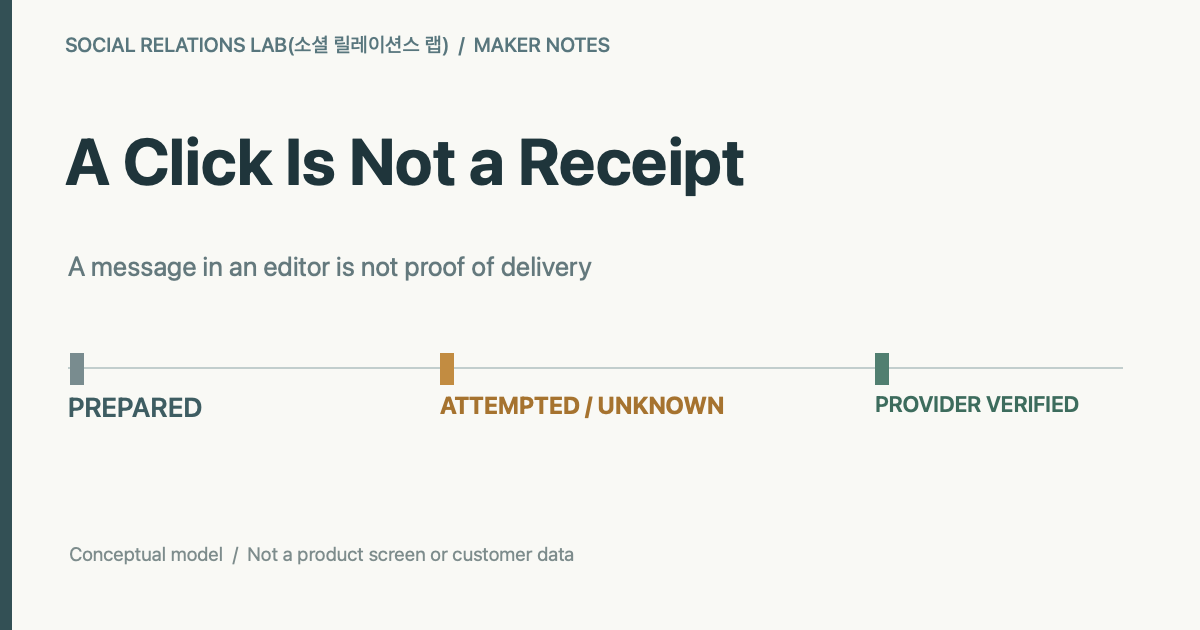
The small failure I could actually observe
On October 26, 2026, I attempted one relevant comment on each of two separate public posts in my own community workflow. I checked the intended account, the source context and the message before interacting with the native comment editor.
The actual text fields matched the reviewed text. I attempted the native submission action. Yet independent reloads did not show the new comments, and neither attempt yielded a unique provider comment reference.
I cannot attribute the failure to a particular component. The background interface, authentication state, network handling or provider processing might be involved. Without reliable evidence I cannot call these attempts either accepted publications or confirmed non-delivery.
Three states instead of one optimistic counter
| State | Evidence | Appropriate next step |
|---|---|---|
| PREPARED | Reviewed content, target, account and duplicate-prevention key | Validate permission before the initial attempt |
| ATTEMPTED_UNKNOWN | An attempt timestamp but no accepted provider ID | Hold retries and reconcile through permitted platform records |
| PROVIDER_VERIFIED | A real comment ID or unique permalink with observation time | Count the publication; measure human response separately |
The tempting shortcut is to name a local event “posted” when a button is clicked. It makes a dashboard appear productive but says nothing about what another person could actually see.
The opposite shortcut is unsafe too. If a comment is not visible immediately, clicking again might duplicate a delayed, successfully processed attempt. Unknown delivery must remain a distinct state.
The operating decision I changed
I now treat account, channel, exact source post and message version as part of a single action claim. I preserve the reviewed text before the first attempt. If delivery becomes ambiguous, I do not resend it merely because it is missing from one page refresh.
Only a provider-issued reference or an independently verified public permalink should move that action into the published column. Any voluntary response from the other person needs a different piece of evidence. Posting a message, receiving a reply and having a meaningful conversation are three separate outcomes.
This is an operating principle, not a claim that every platform exposes the same receipt or retention history. Some results may remain unresolved.
Why this matters for Social Relations Lab
Social Relations Lab(소셜 릴레이션스 랩) is an unfinished relationship-intelligence experiment. Its direction is to preserve the provenance and context of authorized social interactions over time so a human can make an informed next decision.
The validated initial scope is limited to a local pilot handling comments and owner replies from one specifically authorized Instagram Professional account. In the earlier article on what comment evidence can tell us, I described the limits of interpreting incoming interactions.
This entry concerns the other side: proving that an outgoing action occurred at all. The state machine above is a design lesson from an operating experiment, not a claim that a customer-facing automated outbox, broader messaging access or public beta has been built.
One falsifiable next question
Consider two synthetic work records. In the first, the operator has a click timestamp but no provider reference. In the second, the provider has returned a unique ID. Can a new operator correctly identify which action is verified, and resist retrying the ambiguous one?
I have not run that usability experiment or received real customer feedback on it. If the distinction is confusing, explaining uncertainty should come before adding more action-count charts.
The related source-evidence note and blog index offer further context. A full Korean edition is available.
This is a firsthand observation from October 26, 2026. It does not expose a third party’s conversation, assert that the comments were delivered, or claim any product feature was released.