
Six open-source learning lists merged my Space Atlas contributions
Between October 16 and November 6, 2026, six independently maintained open-source learning and science resource lists merged links I submitted for Space Atlas. The original GitHub pull requests document those decisions. A later URL correction in one of the lists is not counted as a seventh placement.
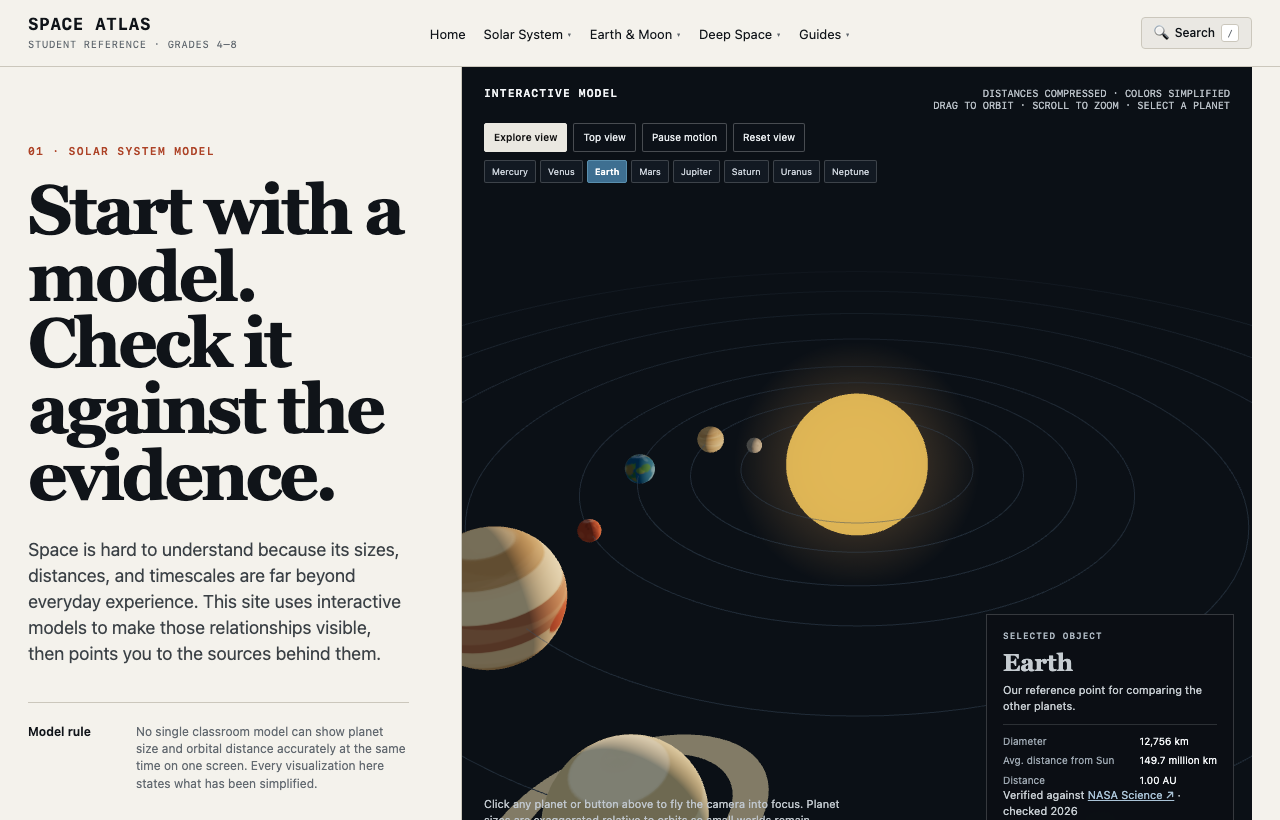
I built Space Atlas to let learners manipulate ideas such as Moon phases, Earth’s seasons, and astronomical scale rather than only read about them. These merges did not release a new simulator. They made an existing working project easier to discover in collections maintained for different educational purposes.
Six original contributions, six independent maintainers
These are the UTC merge dates. Each link opens the actual proposed change and its merge record.
- October 16 — Awesome Study Resources PR #404: Free interactive study material.
- October 16 — Awesome Interactive Learning PR #2: Models for exploring Moon phases and seasons.
- October 20 — Awesome MINT Kids Resources PR #2: Parent- and teacher-guided science activities.
- October 27 — Kids Edutainment Links PR #11: Astronomy activities families can explore.
- November 5 — Awesome Physics PR #19: Open-source astronomy models within an astrophysics collection.
- November 6 — Awesome Homeschooling PR #9: Browser-based models for home science lessons.
I authored each change, and a maintainer other than me merged each one. All six current default-branch READMEs still contain an entry for Space Atlas. Awesome MINT Kids Resources PR #5 later updated the link to the canonical domain; that was a correction to an existing listing, not another independent placement.
The software behind the links
In the Moon Phases simulator, learners move the Moon around Earth and compare its sunlit half with the illuminated portion visible to an observer. In the Earth’s Seasons model, they change axial tilt to explore why Earth–Sun distance alone cannot explain summer and winter. The development goal was to turn a question into something a learner could test.
A useful resource-list entry also has to distinguish between the working learning website and the open-source code repository. Some collections link to one, others to the other. The descriptions need to match what the software does, rather than promise a complete curriculum or professional astronomical predictions.
The six merges show that independent maintainers accepted resource-list edits. They do not establish classroom adoption or measured learning gains. Educators should review the site’s current privacy and advertising notices before using it with learners.
For the implementation details, see my Space Atlas development notes. The separate NCASE and Share My Lesson case explains how one model became a short lesson activity.