
Space Atlas: 3D Interactive Astronomy Reference
한국어 버전: 이 글의 한국어 원문은 Space Atlas: 3D 인터랙티브 우주 과학 아틀라스에서 확인하실 수 있습니다.
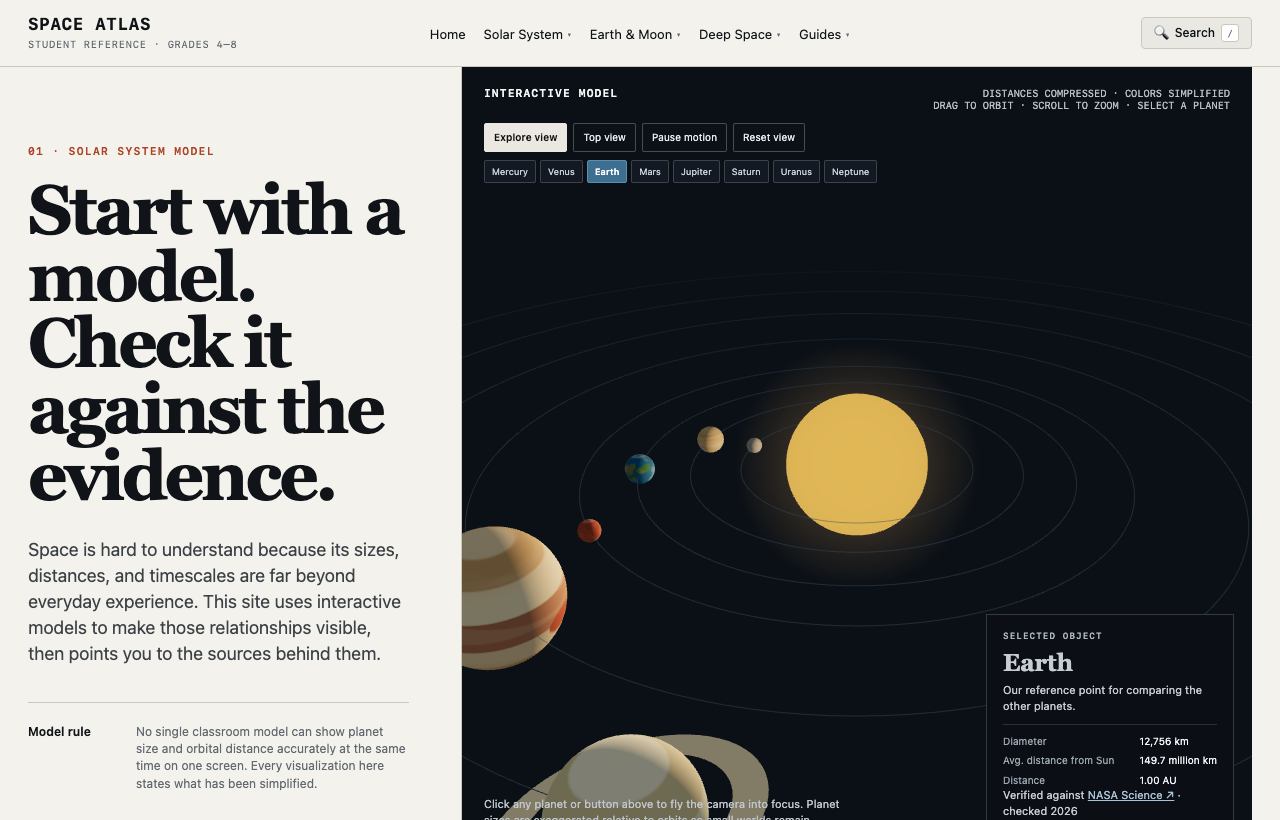
“Why do textbook diagrams of the Solar System distort actual orbital scales?”
“Are Earth’s seasons caused by distance from the Sun, or by axial tilt?”
When students learn astronomy, the two biggest hurdles are the unimaginable physical scale of space and the persistent misconceptions created by flat textbook illustrations.
Try the interactive astronomy tools directly
- Moon Phase Simulator — interactive Sun-Earth-Moon model
- Seasons Simulator — compare Earth’s 23.5° tilt with 0° tilt
- Mars Weight Calculator — compare your weight on every planet
- Age on Other Planets Calculator — convert your Earth age using each planet’s orbital period
- Interactive Planet Size Comparison — Earth vs Jupiter, Mars, Venus, and more
- Solar System Scale Model — calculate real planet distances
- Exoplanet Transit Simulator — move a planet across a star and read the light curve
- Tidal Locking Simulator — why we always see nearly the same side of the Moon
Built to solve these problems, Space Atlas (Student Reference) is an interactive astronomy encyclopedia where students manipulate simulation variables, rotate 3D viewpoints, and discover physical relationships firsthand.
Core Modules and Visual Experiments
Space Atlas organizes 27 core astronomy topics into four primary clusters.
1. Moon Phases and Eclipses Interactive Lab
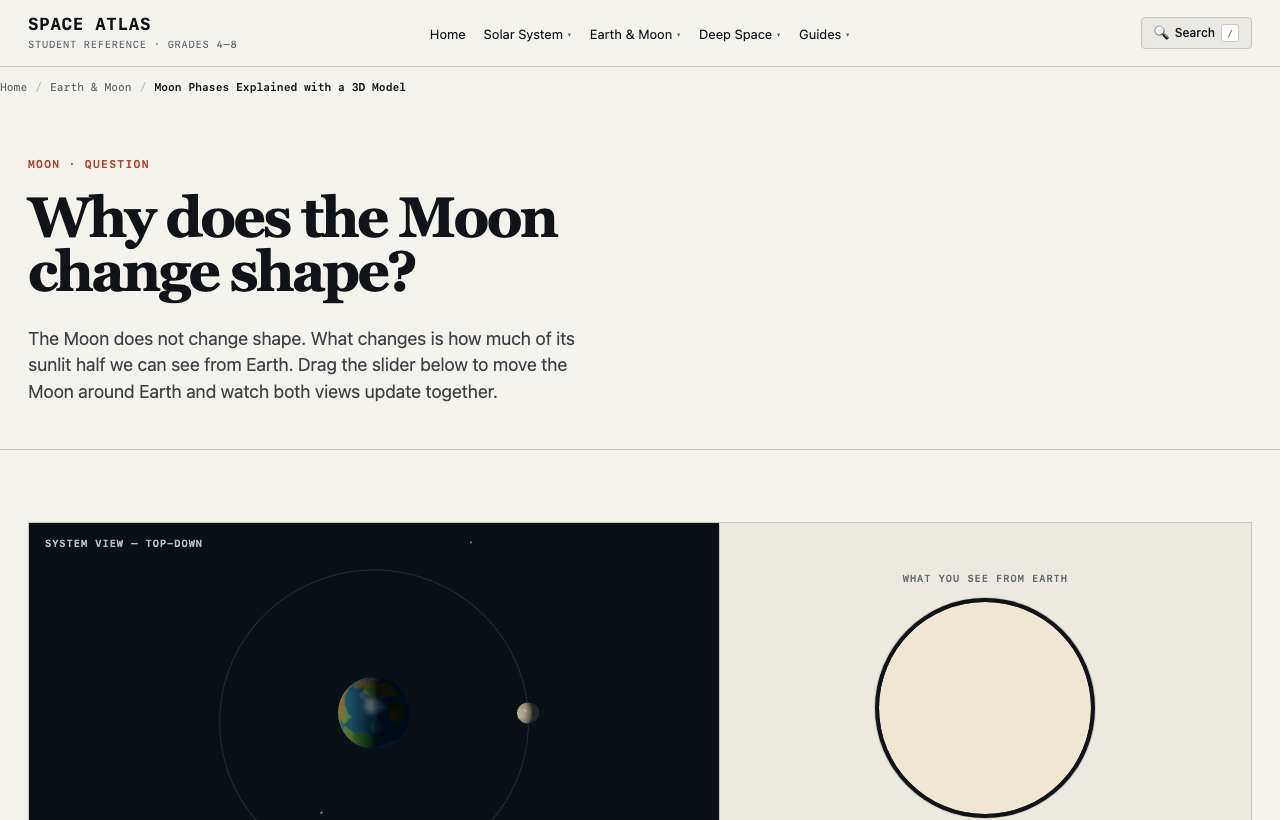
- Synchronized System View and Earth View:
- Dragging the Moon’s orbit in the left 3D viewport updates the right 2D canvas in real time, rendering the illuminated fraction seen from Earth (crescent, quarter, gibbous, full).
- Students visually contrast the sunlit physical hemisphere with the apparent shape seen by an observer on Earth.
2. Newton’s Cannonball Orbital Simulator
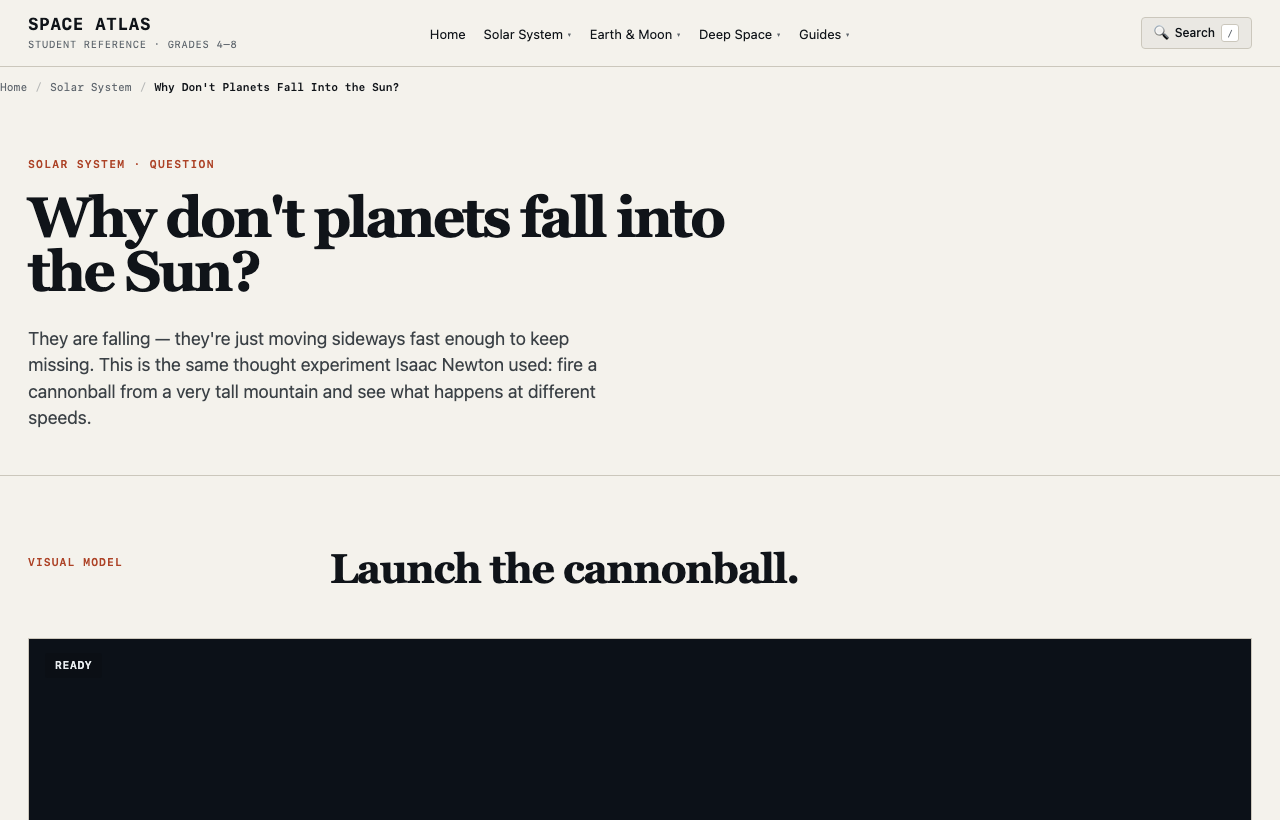
- Real-Time 2D Canvas Physics:
- Addresses the question: “Why do planets not crash into the Sun?”
- Testing different launch velocities reveals:
- Sub-orbital speed: The cannonball falls back to Earth.
- Orbital speed (~7.9 km/s): A stable circular orbit forms around Earth.
- Escape velocity: The trajectory becomes hyperbolic, escaping Earth’s gravitational field.
3. Planetary Scale Lab
- True planetary diameter ratios (e.g., how many Earths fit inside Jupiter).
- True distance ratios (1 AU scale) compared against compressed textbook layouts using an interactive slider.
4. Deep Space and Exoplanets
- Exoplanet Transit Method: Dragging a planet across a star plots real-time light curve dips.
- Star Life Cycle: Interactive paths showing how stellar mass determines white dwarf vs. supernova vs. black hole outcomes.
- Earth’s Galactic Address: Step-by-step cosmic zoom from the Local Group down to the Orion Arm.
Epistemic Learning Structure (NGSS-Aligned)
Every topic adheres to a 7-step learning framework designed to build scientific intuition:
- Question: Starts with an intuitive question (“Why is Venus hotter than Mercury?”).
- Visual Model: Interactive 3D Three.js scene or 2D physics canvas.
- What’s Simplified: Explicitly discloses model limitations (e.g., “Earth-Moon distance is compressed by 30x for screen readability”), preventing students from confusing models with reality.
- Measurable Facts: Quantifiable values such as orbital periods, surface temperatures, and escape velocities.
- Misconception Check: An interactive, self-grading quiz addressing common intuitive traps.
- Evidence: Direct reference links to NASA Science, JPL Education, and ESA data.
- Next Exploration: Continuous learning loop recommending the next logical topic in the series (e.g., Moon Phases -> Eclipses -> Tides).
Recommended Use Cases
- K-12 Students and Science Educators:
- Classroom visualization tool for digital whiteboards and tablets during lessons on lunar phases, seasons, and planetary scales.
- Astronomy Beginners and Curious Learners:
- Visual exploration of astrophysics without complex mathematics.
- Web Developers and WebGL Enthusiasts:
- Reference implementation of a high-performance, zero-dependency 3D educational web application using pure Three.js (ES Modules), Canvas API, and a custom Python static site builder (
build.py).
- Reference implementation of a high-performance, zero-dependency 3D educational web application using pure Three.js (ES Modules), Canvas API, and a custom Python static site builder (
Technical Highlights
- Zero-Dependency Architecture: No Node.js build overhead; uses standard Python stdlib for builds, keeping CI/CD pipeline execution under 20 seconds.
- Instant Topic Search: Pressing
/opens an instant search modal that filters all 27 topics locally. - Responsive Touch Controls: Full support for mobile and tablet touch gestures across all simulations.
Links
- Space Atlas Website: https://saramjh.github.io/space_atlas_student/
- GitHub Repository: https://github.com/saramjh/space_atlas_student