
I repaired two data-loss boundaries in Spoonie
I changed Spoonie’s post-and-poll save from two independent writes to one PostgreSQL transaction. In PR #25, merged November 11, 2026, I also reversed an account-deletion sequence that could remove a person’s photos before the database deletion had succeeded. Both changes concern the result a user is left with when an operation fails.
One save should have one committed result
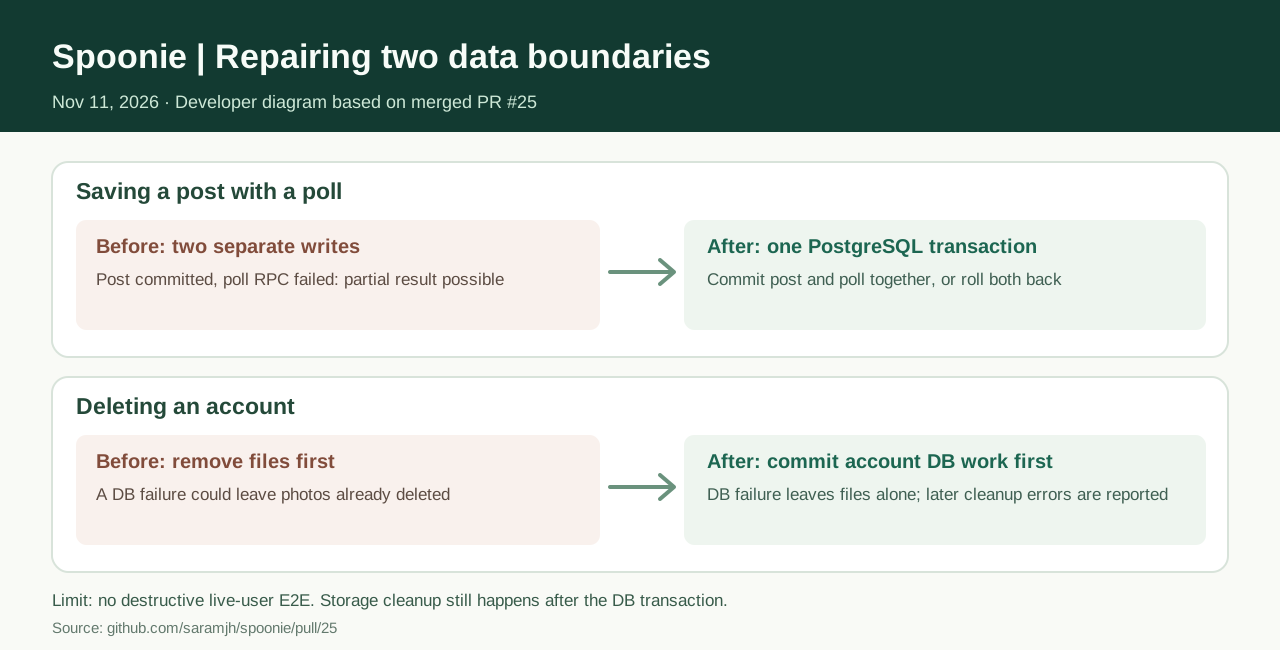
Spoonie’s Recipe and Recipeed editors previously committed the post first, then called a second RPC to save its optional poll. If the poll request failed, the post could remain without the intended poll. The form carried a separate error path, and mismatched draft keys made recovery of new and edited poll options less reliable.
The merged implementation calls save_item_with_poll_atomic to save the item and apply the poll operation inside one PostgreSQL transaction. For Recipes, it reuses the existing save_recipe_atomic routine. For the poll, it calls the existing save_item_poll, which already handles authorship and restrictions on changing options after votes. That avoids rebuilding those checks in a second SQL path. A failure rolls back the item and poll changes together.
The Recipeed branch writes only allowed fields for the authenticated owner, using auth.uid(). The function is SECURITY INVOKER and grants execution to authenticated, not anonymous callers. The editor marks its save complete and clears its draft only after this single operation succeeds.
Delete the account record before deleting its photos
The previous deletion route removed image files before calling the database routine. If the latter failed, the account could still exist while its images were gone. Changing that order was more important than adding another retry button.
The new route checks the current user, the server-side secret and storage-read availability before attempting the database operation. Only after delete_user_data succeeds does it remove the user’s stored images and avatar. On a database failure, it does not delete those files. If a later storage cleanup fails, the response identifies the partial outcome with media_cleanup_pending.
This is deliberately not described as a distributed transaction: the database operation and Storage API cleanup still have a boundary between them.
What I could verify
The original PR records 363 passing Vitest tests across 82 files, a TypeScript check and a successful Next.js 16 production build. It also documents a read-only check of the operating Supabase permissions and the applied migration for the new database function. I have not independently verified that the newly merged frontend code is active in the production member flow.
The technical lesson is a practical one: a product can appear to save correctly in the normal case while producing the wrong result after the second operation fails. Putting the commit boundary in the database, and handling file cleanup as a separately reported step, makes those failure states more explicit. The original work did not run a destructive end-to-end deletion against a real member account; its failure coverage is based on tests.
Related first-party records: the public Recipe poll, the Spoonie project, and the merged source PR #25.