
I shipped a directory for Spoonie's 18 editorial profiles
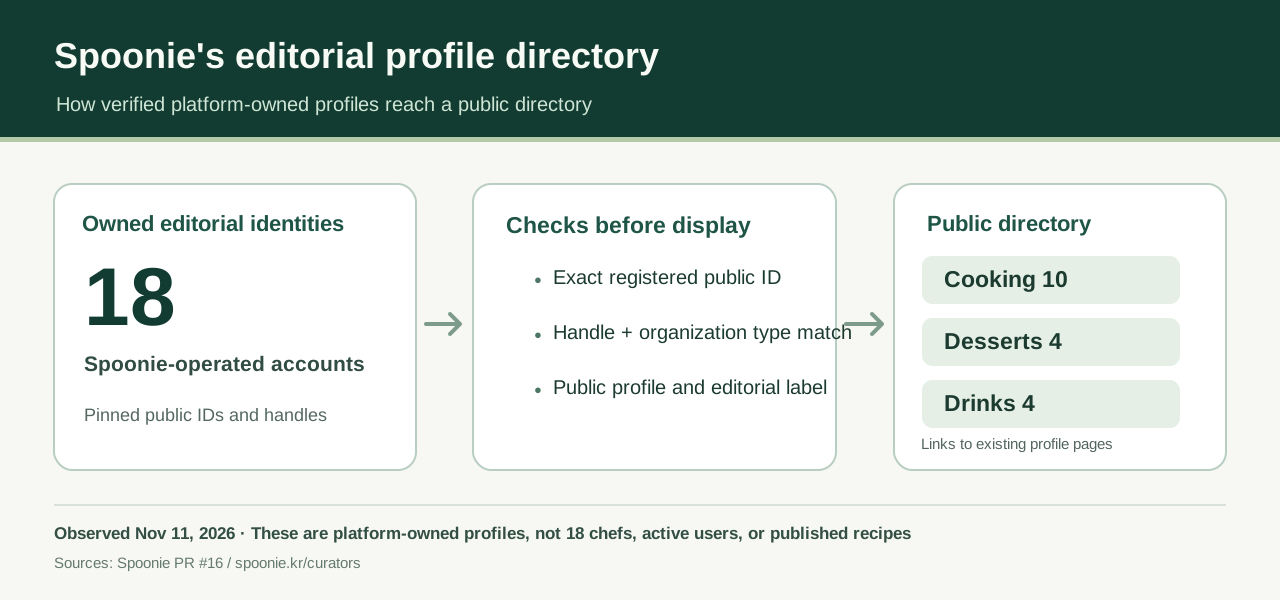
I built and shipped a public directory for Spoonie’s editorial profiles. On November 11, 2026, the live page displayed links to 18 profiles: ten for cooking, four for desserts and four for drinks. These are Spoonie-operated editorial identities for introducing recipes. They are not evidence that 18 independent chefs signed up, or that 18 contributors are already publishing.
Make official identity something the code checks
A directory can be assembled by searching for matching names. I did not want an ordinary member with a similar profile name to appear as an official Spoonie editor.
In merged PR #16, I pinned the expected public identifiers and fetched their matching public profiles. Before displaying an entry, the code checks the profile’s identifier, account handle, organization type, public visibility and editorial profile description. An unrelated or mismatched profile is left out. If the public-profile query fails, the page shows an unavailable state instead of filling the screen with invented accounts or activity.
The result is a small but useful ownership boundary. Public profile data can be read for display, while account provisioning remains a separate administrative operation. I did not move privileged account creation or service keys into the public browser.
What a visitor can actually use
The directory groups profiles by cooking, desserts and drinks, then links each one to Spoonie’s existing profile view. It reuses the product’s profile and follow entry points rather than introducing a separate social identity system.
There is a disclosure below the list: the curators are recipe-introduction accounts operated by Spoonie, while an individual recipe’s creator and source are identified on that recipe. I wanted that boundary visible on the page, not just documented in code.
At the time PR #16 merged, these editorial accounts had not yet published new recipes. The directory was therefore configured with noindex, follow. I verified that setting and the 18 public profile links in the live HTML on November 11. The directory being online does not establish readership, actual follows or an active recipe catalogue.
The developer result
The practical achievement is an identity-aware directory integrated with an existing product: a controlled set of public accounts, checks that exclude lookalikes, and links to the existing profile interface. It is a foundation for editorial discovery rather than a claim of community traction.
The next meaningful evidence will come from recipes published with their own source and image rights intact, followed by real reader behavior. I use the same distinction in my Spoonie recipe-poll implementation: shipped code and a working public example can be verified, while adoption requires separate measurement.
Sources: live Spoonie editorial directory, original merged implementation PR #16, Spoonie project case.