
The SHA-256 matched. The Korean caption was already broken.
A matching SHA-256 confirms that some bytes match a reference. It does not confirm the writer’s words survived. I ran into that distinction while checking a Korean-language caption prepared for a social post.
The file contained 385 bytes, including 116 literal question marks and zero Hangul syllables. Every byte was ASCII, and its SHA-256 matched the stored asset hash. I withdrew the local publication candidate. That check does not establish when the text was damaged or what, if anything, happened on a separate publishing platform.
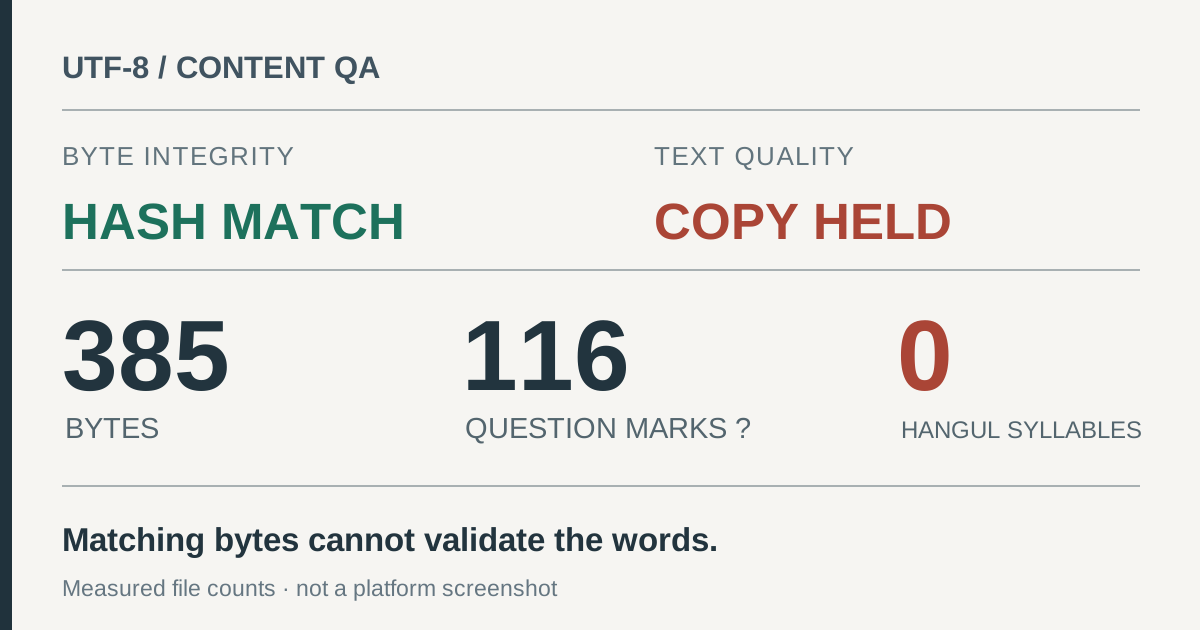
Two different tests
SHA-256 measures the bytes supplied to it. That is useful for detecting changes during storage or transfer. But if a file was already damaged when its reference hash was calculated, a perfect match only certifies those same damaged bytes.
The symptom here was not � (U+FFFD), the Unicode replacement character. It was the ordinary ASCII question mark, ?. A strict UTF-8 decoder accepts an ASCII-only file. So successful UTF-8 decoding is necessary for many workflows, but it does not prove the Korean source text remains intact.
Reproduce a failure mode, not the incident’s cause
One possible route to similar output is ASCII encoding with character replacement:
source = "한글 문안"
corrupted = source.encode("ascii", errors="replace")
assert corrupted == b"?? ??"
assert corrupted.decode("utf-8", errors="strict") == "?? ??"
This is a controlled example, not a root-cause finding for the original file. It demonstrates how information can be lost while the resulting bytes still pass UTF-8 decoding. Python documents the ? substitution in its codec error handlers and SHA-256’s byte-based interface in hashlib.
Add a language-aware gate
For an asset explicitly designated as a Korean caption, check for expected text separately from the digest:
from pathlib import Path
import hashlib
import re

payload = Path("caption.txt").read_bytes()
text = payload.decode("utf-8", errors="strict")

if "\ufffd" in text:
    raise ValueError("Unicode replacement character found")
if not re.search(r"[\uac00-\ud7a3]", text):
    raise ValueError("Expected Korean copy; found no Hangul")

digest = hashlib.sha256(payload).hexdigest()
print(digest)  # Separate byte-integrity check
The language condition matters. An English-only caption should not fail for containing no Hangul; a partly damaged Korean caption might still contain a few. Production review needs a source text to compare against, the appropriate language expectations and a read of the final rendered copy. A character count or hash is not editorial approval.
What remains unknown
Question marks alone cannot reconstruct the missing Hangul. The inspected file does not identify the application or conversion step that replaced the characters. Nor does a local asset audit establish a platform publication outcome.
In an earlier portfolio regression note, a browser test failed after the number of evidence entries changed. This time, the weak point was in the content pipeline: the deterministic file fingerprint passed even though the words had already disappeared.