
A Jekyll footer link for changing an earlier ad-consent choice
A consent message can disappear once a visitor has made a choice. That leaves a practical question: where can they change the choice later? On October 8, 2026, I added a privacy choices link to the footer of ad-enabled articles on my Jekyll blog. The link appears only after Google’s consent API is ready and TCF data reports gdprApplies: true. The original implementation is in commit d3ce5a1.
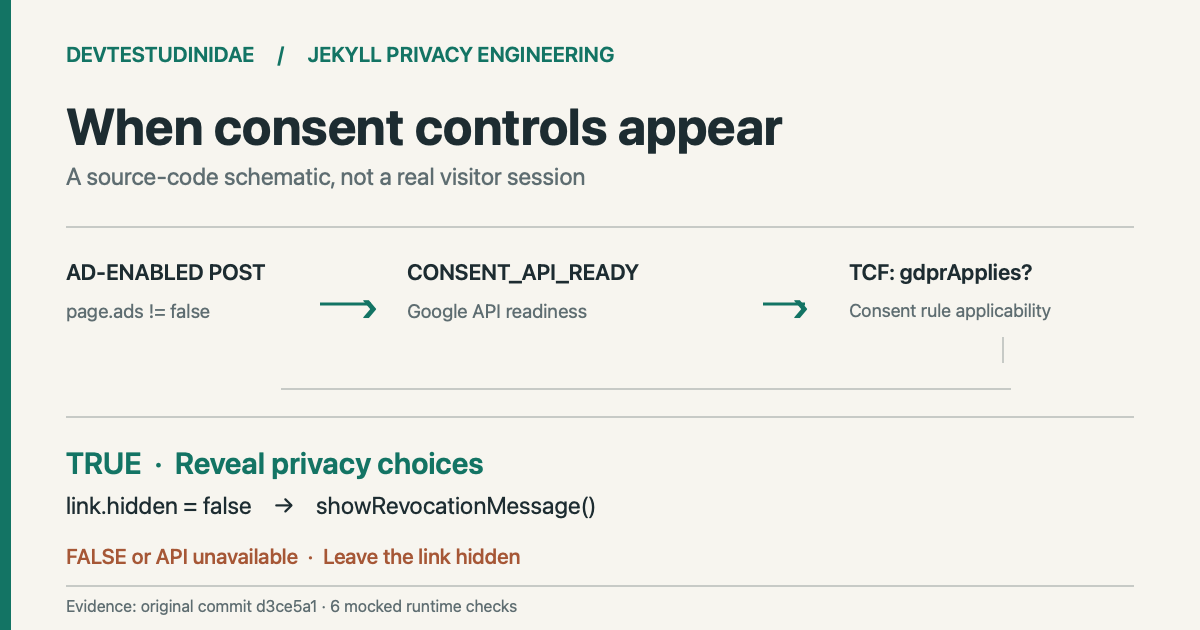
Give the visitor a route back to consent settings
The blog’s privacy policy already described advertising choices and browser storage. Its ordinary article footer, however, had no dedicated control for reopening the previous ad-consent decision. I put that entry point in the footer of articles that use AdSense, with conditions to keep it out of pages that do not use advertising.
Google’s Privacy & messaging JavaScript API reference documents showRevocationMessage(), which clears a previous EU regulations consent record and shows the message again. The same documentation describes waiting for CONSENT_API_READY and checking the TCF gdprApplies flag before revealing a link.
Keep the link hidden until the API answers
The Jekyll template emits a footer link with the hidden attribute. It does so only for production builds with AdSense configured, an article date, advertising enabled on the page and no redirect. This excludes the homepage and the ad-free privacy policy.
On the client, the footer registers a CONSENT_API_READY callback with googlefc.callbackQueue. When that callback runs, the code checks for __tcfapi and subscribes using addEventListener with version 0. The event result has to succeed, report that the relevant regulations apply, and expose the revocation method.
window.googlefc.callbackQueue.push({
  CONSENT_API_READY: function () {
    if (typeof window.__tcfapi !== "function") return;
    window.__tcfapi("addEventListener", 0, function (tcData, success) {
      if (success && tcData && tcData.gdprApplies &&
          typeof window.googlefc.showRevocationMessage === "function") {
        link.hidden = false;
      }
    });
  }
});
This is an excerpt from the actual footer source. A click handler prevents navigation to # and calls googlefc.showRevocationMessage(). Missing APIs and unsuccessful checks leave the link hidden.
Test the code paths without claiming live consent outcomes
I extracted the footer’s JavaScript and ran six scenarios in an isolated Node environment. The test replaced browser and provider callbacks with controlled functions.
| Mocked condition | Observed code behavior |
|---|---|
gdprApplies=true, required APIs present | Link appears; clicking calls the revocation function once |
gdprApplies=false | Link stays hidden |
| TCF callback reports failure | Link stays hidden |
__tcfapi is absent | Link stays hidden |
| Revocation method is absent | Link stays hidden |
| Footer link element is absent | Script exits without registering a callback |
The reproducible runtime probe makes no requests to Google’s consent service.
I also fetched an existing article and the privacy policy from the public blog. Both returned HTTP 200. The article HTML contained the conditional link and revocation handler; the privacy page contained neither. That confirms deployed markup, not the experience of an actual visitor under European regulations.
What remains outside the test
If Google’s consent API is unavailable or the region/applicability check never completes, this design leaves the link hidden. A hidden control alone cannot guarantee that every visitor has a route to change a consent decision. The regional message configuration and a real end-to-end consent change require separate verification. These code checks also do not establish legal compliance.
This case verifies the Jekyll rendering conditions and browser callback paths. I have no user-level consent outcome, advertising result or traffic measurement from it. For a separate privacy-related engineering incident on the same blog, see the Do Not Track loader and HTML compression regression.