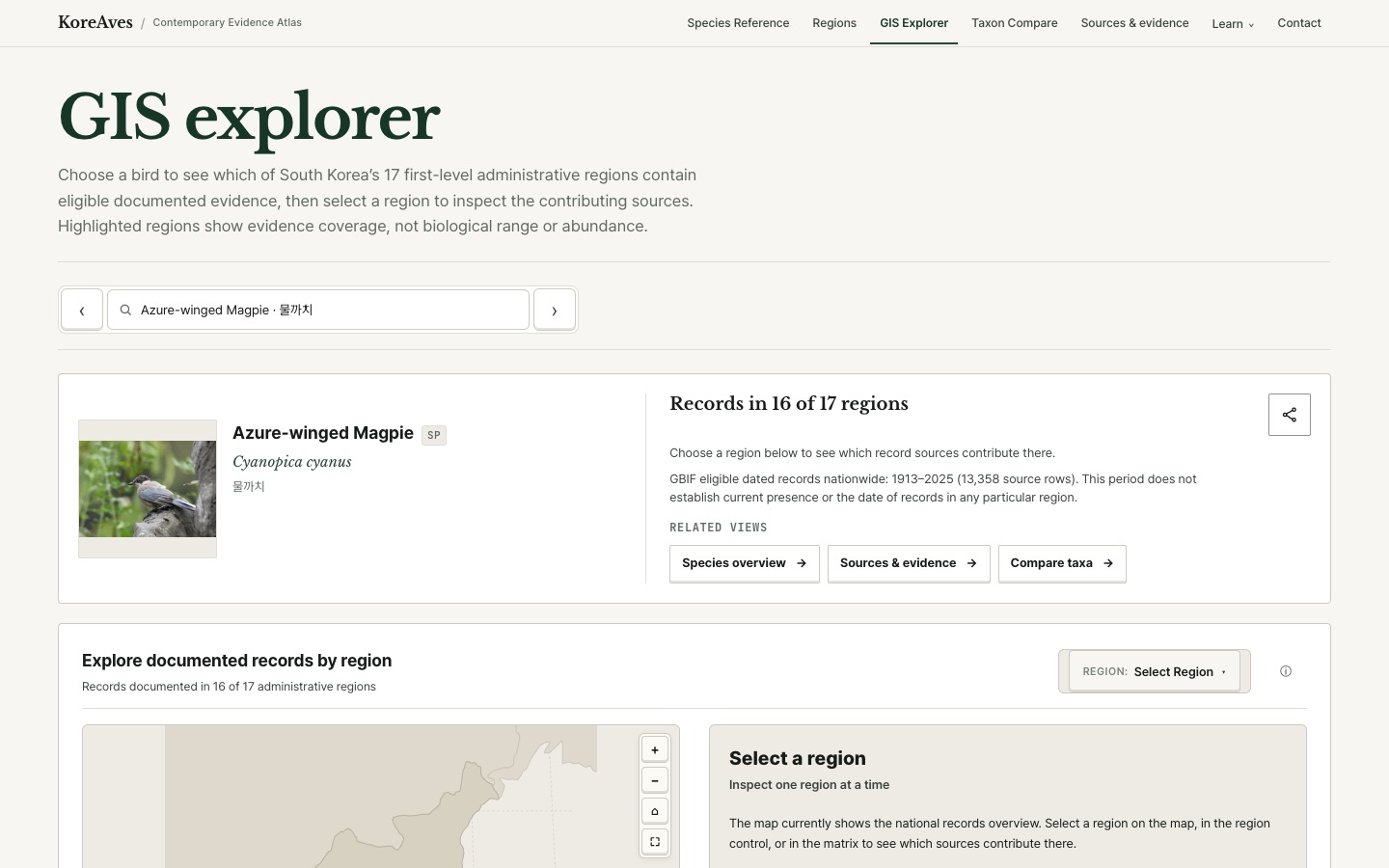
In October 2026, two pieces carrying my author credit appeared on 10,000 Birds, a website focused on birds and birding. They gave me a different way to explain what I had learned while developing KoreAves: not as a list of software features, but as questions about evidence, permissions and how readers encounter birds and places.
These are published contributions, not institutional partnerships or scientific papers. Both publication pages and author credits can be checked directly.
October 6: the photograph problem
On October 6, 2026, 10,000 Birds published The Bird Photo I Could Use Was Not The Bird Photo I Wanted, credited in the article body to Jihun Oh.
The central tension is familiar to anyone who works with public datasets and images: availability in search results is not permission to republish. Nor is an attractive photograph automatically adequate evidence for a precise species or subspecies identification. That tension influenced KoreAves’s approach to media provenance.
It was a useful opportunity to turn an engineering trade-off into something a birding reader could understand without knowing the system architecture.
October 30: a place rather than a feature
On October 30, 2026, the site published Suncheon Bay Wetland, South Korea — Profile for Birders. The page is posted under the site’s editorial byline but includes the internal credit “By Jihun Oh.”
The article combines published visitor and conservation information about the wetland with a source-based guide for birders. It explicitly says that the account is not based on my recent firsthand sightings there. That is an important boundary: an informative destination profile can be carefully sourced without pretending to be a field report.
What the publications demonstrate
The evidence supports a narrow but meaningful statement: two authored pieces were published on an independent birding website on the dates above. They do not, by themselves, demonstrate a partnership, audience size, institutional endorsement or project adoption.
Writing for an external audience prompted me to make the reasoning understandable without falling back on product jargon. The same discipline helps build interfaces: when a label implies more certainty than the data warrants, it needs to change.
Continuing the work
I want to make KoreAves more useful as a reference that visitors can question and verify. That means documenting sources, correcting uncertain identities, and refusing to let attractive presentation substitute for a defensible record.
The KoreAves project case study collects the technical context; the external resource-listing article tracks a different kind of milestone.