
Publishing Spoonie's first-record problem on Disquiet
On October 13, 2026, I published a first-person account of Spoonie’s early user problem on Disquiet. The Korean article, 레시피 SNS를 만들고 깨달은 것: 기능보다 먼저 ‘첫 기록의 이유’가 필요했다, appeared under the DevTestudinidae author name. It described a problem that remained after I had built the features of a cooking community: giving a visitor a useful reason to make their first personal record.
I wanted to explain the product decision in public, where other developers could examine the question. A working recipe calculator, a publishing form, and a social feed are things I can build and demonstrate. They do not, by themselves, explain why someone should spend time contributing to a new community.
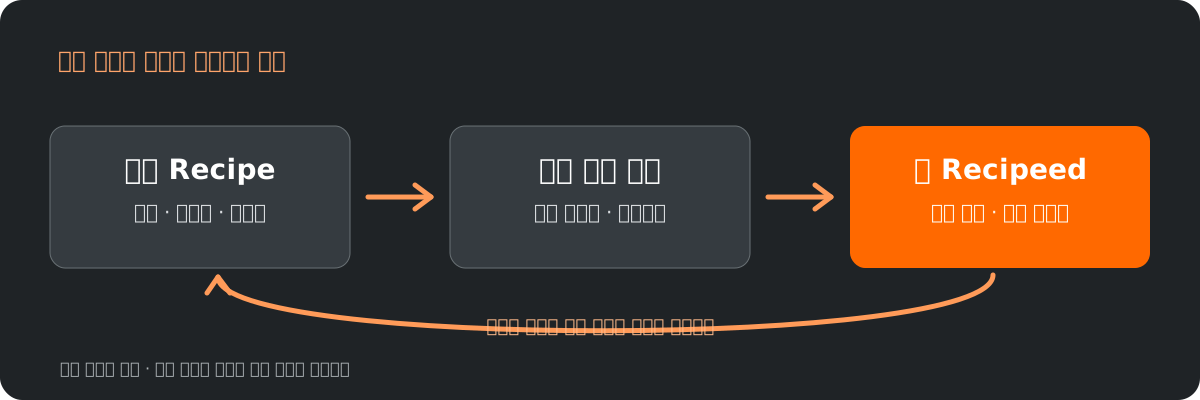
The problem that remained after the features worked
I built Spoonie around two kinds of content. A Recipe holds the ingredients and cooking steps. A Recipeed records what someone cooked, the photo they took, and changes they made. When a Recipe has serving-size information, readers can adjust the amount and review the corresponding ingredient quantities.
Public Recipes are available to read without creating an account. Writing a Recipeed requires signing in. That distinction matters when the product is new. Asking for registration before someone has found anything worth using creates a different first experience from letting them solve a cooking problem and decide whether to leave a record afterward.
The central question in my Disquiet article was simple: why should a person make their first cooking record here? Making the form shorter might help a willing contributor. It cannot supply a reason to contribute in the first place.
Separating exposure from a first contribution
For a community product, it is tempting to count published promotional posts as progress toward active participation. I wanted to keep those events separate.
A visitor can open a Recipe without registering. Someone who registers may still never publish. A first Recipeed is a different event again, and a person returning to record another meal would tell me something that a one-time post cannot. Each stage requires its own evidence before I can describe it as an outcome.
In the October 13 article, I explicitly said that I could not yet claim a verified first Recipeed from a newly recruited outside creator. That statement described what I could substantiate at publication time. It does not establish the product’s present participation numbers, and I am not treating later activity as if it were already known then.
The design experiment was to lead with an immediate task: find a public recipe, check ingredient quantities for the serving size, cook, and then decide whether keeping a personal record would help next time. I was testing whether that order made more sense to a visitor than asking them to join another social network.
What this publication demonstrates
Publishing the retrospective on Disquiet gave me a public, dated account of how I connected the implementation to a product question. I had worked on the content structure and the interface, then identified the behavior those features still needed to support.
That is a useful developer work sample for someone considering a community product. The original Disquiet article documents the reasoning. A reader can also open a real public Spoonie Recipe and compare the experience with the questions I wrote about.
The broader Recipe and Recipeed design is explained in my earlier development log. A separate Web Apps Directory listing records an external discovery route for the finished public service. Those are different kinds of evidence, and I keep them separate.
This was a self-authored developer article on an external community platform. It was not an independent review, and the publication itself does not establish user adoption or conversion growth.