
Spoonie is listed in Web Apps Directory's Food & Drink catalogue
Spoonie has a public entry in Web Apps Directory’s Food & Drink category. The directory labels the entry “Catalogued October 25, 2026” and links directly to spoonie.kr. People looking through its web-app catalogue can now find a Korean home-cooking service that I built outside the service’s own website.
The entry describes recipe discovery, ingredient quantities that adapt to serving size, and a way for users to record what they cooked. Those are useful starting points for someone encountering Spoonie for the first time. The product idea goes further: I want a recipe and the experience of someone who tried it to remain connected.
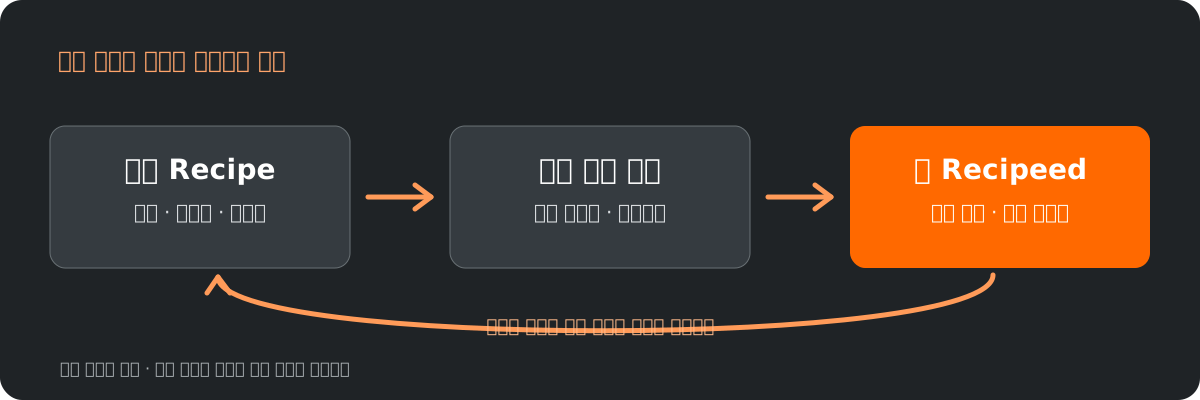
The work behind a small directory entry
I separated two kinds of content in the product. A Recipe is the structured source: ingredients, quantities, cooking instructions and an author. A Recipeed is a record of an actual cooking attempt, such as a finished dish, a substitution or a short note about the outcome. When the cook identifies the Recipe they followed, the product can preserve that reference.
Serving-size adjustment solves a different, immediate problem. A person making a dish for one or four people should be able to see appropriate ingredient quantities without rewriting the recipe. The live Spoonie site describes the search, ingredient and cooking-record workflow, and a public Recipe gives visitors a concrete page to inspect.
I worked on the boundary between these experiences: a recipe needs a reliable source, and someone’s cooking note should remain their own story. Making that distinction visible in a browser interface is a product-design and data-modeling problem, not simply a matter of storing another photograph.
What an external catalogue changes
The directory adds a discovery route alongside Spoonie’s own pages and direct links: its Food & Drink catalogue now contains an entry describing the product and linking to the actual service. It also classifies Spoonie as a browser app, so a visitor knows that the product can be opened from a web browser.
This gives a prospective collaborator or international reader a public, independently hosted reference to examine alongside the working product. Someone evaluating a recipe platform can check whether the directory’s description matches the experience on Spoonie. It is also a modest exercise in making a Korean-language product understandable to an audience that may first discover it through an English catalogue.
I can point to the listing as evidence of external discoverability. It does not establish a change in registrations, repeated cooking records or referrals from the directory. The current Korean-language interface also limits immediate use by people who do not read Korean.
What I would measure next
The next question is whether someone who discovers a recipe follows it, leaves a cooking record and returns for another dish. The product can support that sequence; user retention requires separate, real usage evidence.
For the original record, see the Web Apps Directory entry and the source-linked portfolio archive. The earlier Spoonie Recipe and Recipeed development note explains the social-cooking model in more detail. Open Spoonie to inspect the current interface.