01
False color
Many NASA images use "false color" — mapping infrared, X-ray, or radio data onto colors human eyes can see. The colors are not what your eye would see.
An observation, a simulation, and an artist's concept can all help explain space — but they provide different kinds of evidence. Examine the categories, then compare real Hubble and Webb observations of the same region.
Start with an actual NASA observation, then examine which claims are supported by the image.
The Pillars of Creation are a star-forming region in the Eagle Nebula. These real telescope observations were made with different instruments and filters — and at different times. Select either view to inspect the evidence.
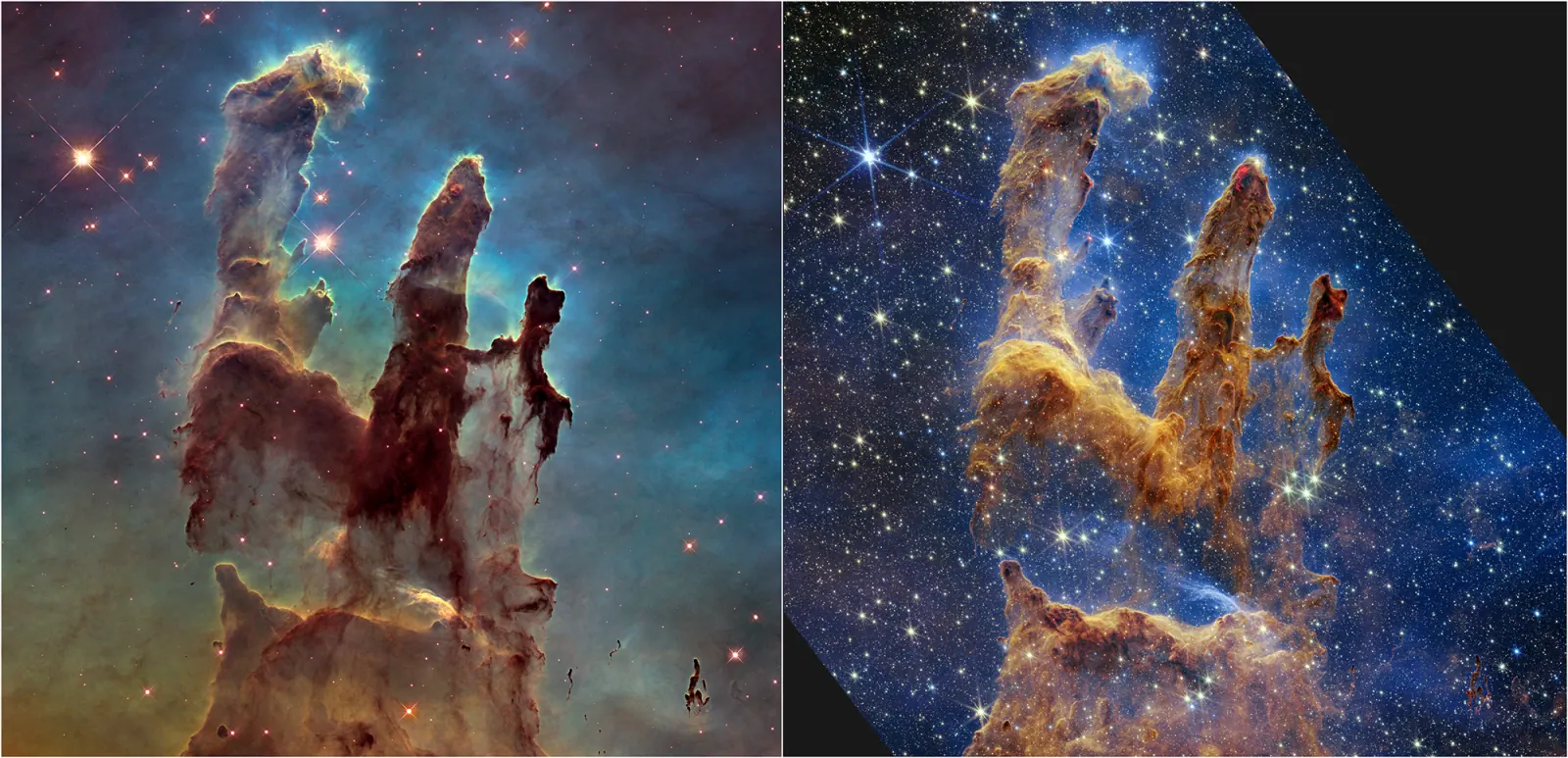
Hubble WFC3/UVIS + Webb NIRCam
On the left, Hubble emphasizes dusty pillars. On the right, Webb's near-infrared data reveals more stars and details within the dust. The difference is about wavelength and instruments — not a before-and-after change over eight years.
These are processed composites of multiple monochrome filter exposures, not single natural-color camera snapshots.
| Question | Hubble · left | Webb · right |
|---|---|---|
| What kind of image? | Instrument observation, processed composite | Instrument observation, processed composite |
| Instrument | WFC3/UVIS | NIRCam |
| Observed | September 2014 | 14 August 2022 |
| Filters & mapped hues | F502N → blue; F657N → green; F673N → red | F090W → purple; F187N → blue; F200W → cyan; F335M → yellow; F444W → orange; F470N → red |
| What becomes clearer? | Thick dust structures | More young stars seen through dusty regions |
The telescope detectors record light through filters. Image processors assign visible display colors to those data layers, register them, and combine them. A color assignment is not evidence that the object emits that visible color to human eyes. The views also differ in resolution, exposure and image processing.
Source and image credit: NASA, ESA, CSA, STScI, Hubble Heritage Project. Image processing: Joseph DePasquale (STScI), Anton Koekemoer (STScI), Alyssa Pagan (STScI). Space Atlas optimized the official composite for delivery; NASA and its partners do not endorse Space Atlas. View NASA's image, observation dates and filter metadata ↗
First identify the source. Then decide what the image can and cannot establish.
The Pillars images above come from real telescope detectors. Their color mappings are assigned, not what a person would see through an eyepiece.
Verify instrument · wavelengths · acquisition date · composite processing
Orbit animations calculate a simplified model. An appealing 3D representation does not mean planet sizes, distances, or speeds are shown to scale.
Verify input variables · model limits · scale · independent observations
A detailed landscape on a distant exoplanet is not a photograph of its surface. Such views may be informed by scientific measurements, but depicted terrain is not observed detail.
Verify explicit concept label · observed facts · speculative features
An observation can be processed, a simulation can use observations, and an illustration can be scientifically informed. These labels describe how evidence supports the image, not a ranking of visual quality. Read the original caption and source before drawing conclusions.
Many NASA images use "false color" — mapping infrared, X-ray, or radio data onto colors human eyes can see. The colors are not what your eye would see.
A single "photo" is often several exposures through different filters, stacked and aligned in software before publication.
Published images may be cropped, rotated, enhanced, or rescaled to communicate a specific result. Check an original release's full image and caption before interpreting what lies outside the frame.
Which site to open for homework.
See the same observation/model/illustration distinctions applied to the 3D solar system.
Explore the electromagnetic spectrum behind observations at different wavelengths.