2026 ED138: could it be the sixth dwarf planet?
Not yet. On 27 October 2026, the NSF–DOE Vera C. Rubin Observatory announced the discovery of 2026 ED138, a large object beyond Neptune. It is a dwarf-planet candidate, not an officially recognized sixth dwarf planet. The International Astronomical Union (IAU) still recognizes five: Ceres, Pluto, Haumea, Makemake and Eris.
The key unanswered question is whether ED138 is large enough for its own gravity to pull it into a nearly round shape. Brightness alone cannot establish its diameter without knowing how reflective its surface is. Rubin's discovery announcement ↗ · IAU classification ↗
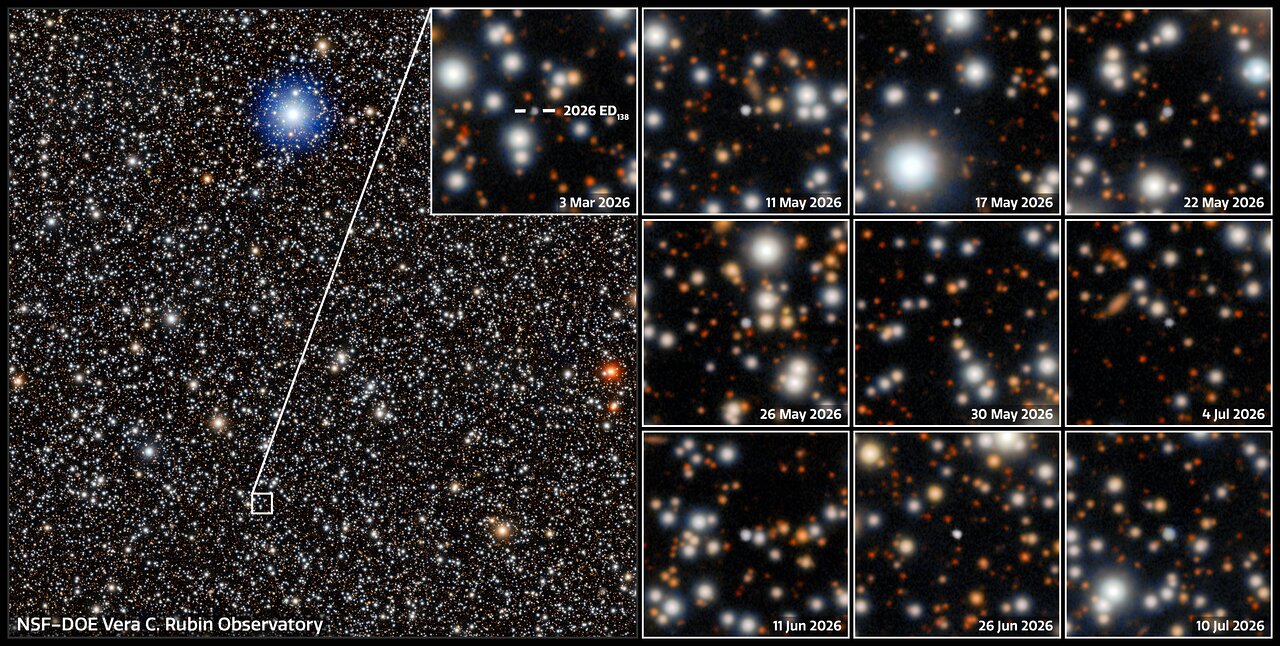
A moving point of light, not a surface photograph.
Rubin tracked the object's movement against a crowded field of Milky Way stars. We have repeated observations of its position and brightness, not a close-up picture of its surface.
- Announced
- 27 Oct 2026
- Discovery
- Vera C. Rubin Observatory
- Diameter estimated
- 612–1,530 km
- Orbit size semimajor axis
- 43.09 AU
- Inclination to reference plane
- 24.4°
- IAU status
- Candidate; not sixth
The orbit's 43.09 AU semimajor axis measures its average geometric scale, not its location on discovery day. The object was roughly 46 AU from the Sun when announced. These values are not interchangeable. Diameter and inclination are from the discovery team's preliminary study; the size interval depends on assumed albedo. Holman et al., 2026 ↗
How can the same light mean two very different sizes?
Predict: if the object reflects less sunlight, must it be larger or smaller to appear equally bright?
Albedo / size inference
Keep observed brightness fixed. Change only reflectivity.
The research reports absolute magnitude HV = 3.19. The slider shows what diameter would produce that brightness under different assumed geometric albedos.
At 10% reflectivity, an object with HV = 3.19 would be about 967 km wide. A darker surface requires a larger body to reflect the same amount of light.
Formula: diameter (km) ≈ 1,329 × 10−H/5 ÷ √(geometric albedo), with HV = 3.19. The highlighted range assumes 4–25% reflectivity, not a measured probability distribution. The comparison uses Pluto's approximate 2,377 km diameter. This diagram encodes diameter only; color, shape, surface and orbit are not inferred. Sources: discovery paper, NASA Pluto facts.
Why isn't ED138 officially the sixth dwarf planet?
A promising size estimate is not the same thing as a demonstrated round shape or a formal classification.
Rubin plus archival observations traced a trans-Neptunian orbit. The 2026 study reports a semimajor axis of 43.09 AU, eccentricity 0.139 and inclination approximately 24.4°.
The unknown albedo leaves a wide diameter interval. Follow-up thermal or occultation measurements can constrain size; shape needs adequate evidence.
The object occupies a trans-Neptunian population. Its current status is a candidate, and this page does not independently assign an IAU classification.
ED138 is observed orbiting the Sun, rather than orbiting a planet as a satellite.
The current official list remains five: Ceres, Pluto, Haumea, Makemake and Eris. "Sixth dwarf planet discovered" is therefore premature. This statement is current as of 31 October 2026. Compare the IAU criteria in our Pluto and dwarf planets lesson.
How was ED138 found in a crowded sky?
Its motion was linked across many images. Earlier archival detections extended its observed history rather than requiring someone to photograph a brand-new planet.
Archival DECam images later extend the observational arc back by more than ten years.
Rubin images record repeated detections against the dense background of Milky Way stars.
Matthew Holman identifies the unusual moving object while analyzing earlier observations.
The Minor Planet Center announces the provisional designation 2026 ED138; Rubin publishes its candidate discovery.
MIT reports a separate TESS precovery study using stacked 2019–2026 observations. Those earlier detections help confirm the orbit, not its shape.
Sources: Rubin discovery release; Holman et al. preliminary research; MIT TESS follow-up.
The short answers.
Did astronomers discover a sixth dwarf planet in 2026?
No official sixth dwarf planet has been recognized. ED138 was announced on 27 October 2026 as a dwarf-planet candidate. The IAU's recognized list still has five.
How big is 2026 ED138 compared with Pluto?
Its estimated diameter is 612–1,530 km under the study's reflectivity assumptions, versus Pluto's approximately 2,377 km. ED138 is smaller under that reported range; its actual diameter is not yet measured precisely.
How far away is 2026 ED138?
Its orbit has a 43.09 AU semimajor axis; it was roughly 46 AU from the Sun at announcement. A semimajor axis is not an object's instantaneous distance. See what one AU means.
What would confirm its dwarf-planet status?
Further observations constraining size, surface reflectivity and roundness, together with appropriate scientific classification. Current data suggest it could qualify, not that it definitely does.
Did ED138 come from the Haumea family?
The discovery paper places ED138 near Neptune's 12:7 resonance, like Haumea. But its redder color argues against membership in Haumea's collisional family. Its exact resonance membership is still uncertain.